Dewatering Tubes
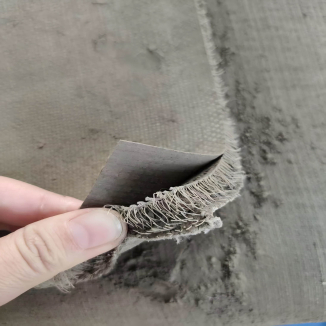
Dewatering Tubes are highly efficient and environmentally friendly materials for sludge dewatering and consolidation. They are made of high-strength polypropylene (PP) or polyester (PET) woven fabrics and feature core characteristics such as large capacity, water permeability and sludge filtration, and UV resistance. By pumping the filling slurry and natural dewatering, the volume reduction and harmless treatment of solid waste can be achieved rapidly. It is widely used in river dredging, tailings treatment and coastline restoration projects. It complies with the ISO 14001 environmental protection standard and is an innovative solution for ecological governance and resource utilization.
I. Material and Process Characteristics
High-strength tube bag fabric
1. Dewatering Tubes' Material: UV-resistant polypropylene (PP) or corrosion-resistant polyester (PET), tensile strength ≥50kN/m (ASTM D4595 standard);
2. Pore size control: Equivalent pore size O₉₀≤0.1mm, permeability ≥0.02cm/s, ensuring efficient water filtration and retention of fine particles.
Structural design
1. Pipe diameter range: 0.5-3.5 meters (customizable), single pipe length: 10-50 meters, filling capacity: 500-3000 cubic meters;
2. Joint strength: High-frequency heat sealing process ensures that the joint peel strength is ≥40N/cm, guaranteeing that the filling will not break under pressure.
Weather resistance
1. Applicable temperature: -30℃ to 80℃, resistant to freeze-thaw cycles ≥50 times;
2. Anti-aging property: UV strength retention ≥85% after 3000 hours, outdoor service life ≥10 years.
Specifications
Item | Units | CWGD50S | CWGD90/120 | CWGD90S | CWGD100S | CWGD120S-B | CWGD120S-C | CWGD130S | CWGD200S-C | |
Breaking strength - radial direction | kN/m | 55 | 90 | 90 | 100 | 130 | 130 | 130 | 220 | |
Fracture strength - weft direction | 50 | 120 | 90 | 100 | 120 | 120 | 130 | 210 | ||
Elongation at break - radial direction | % | 16±1 | 12±1 | 9±1 | 10±1 | 10±1 | 10±1 | 10±1 | 12±1 | |
Elongation at break - weft direction | 10±1 | 8±1 | 8±1 | 8±1 | 8±1 | 8±1 | 8±1 | 8±1 | ||
Breaking strength at an elongation rate of 2% | warp direction | kN/m | 5/15 | 14/40 | 30/30 | 30/30 | 20/40 | 22/40 | 20/45 | 15 |
The breaking strength at 5% elongation | warp direction | kN/m | 14/33 | 38/90 | 75/75 | 75/75 | 80/100 | 84/40 | 80/110 | 90 |
Mass per unit area | g/m² | 285 | 440 | 390 | 430 | 540 | 540 | 560 | 850 | |
Joint tensile strength | kN/m | 35 | 90 | 60 | 70 | 100 | 100 | 110 | 170 | |
Static bursting strength(CBR) | KN | 5 | 10 | 10 | 13 | 15 | 15 | 16 | 22 | |
Dynamic perforation | mm | 10 | 8 | 12 | 12 | 10 | 10 | 11 | 8 | |
Equivalent aperture(0g0) | mm | 0.9 | 0.48 | 0.52 | 0.45 | 0.4 | 0.3 | 0.43 | 0.4 | |
Permeability(Q50) | L/m²/s | 200 | 40 | 20 | 15 | 12 | 6.5 | 15 | 15 | |
Uv resistance (500-hour strong retention rate) | % | 90 | 90 | 85 | 85 | 85 | 85 | 85 | 85 | |

Ii. Function and Engineering Advantages
Efficient dehydration and consolidation
1. After dewatering, the moisture content of the slurry is ≤40%, and its volume is reduced by more than 70%, significantly lowering transportation and disposal costs.
2. The compressive strength of the consolidated body is ≥50kPa, which can be directly used for landfill or resource utilization (such as brick-making, roadbed backfilling).
Environmental Protection and Safety
1. Intercept heavy metals, organic substances and other pollutants to prevent secondary pollution;
2. The flexible structure ADAPTS to foundation settlement and avoids the risk of traditional cofferdam failure.
Convenience of construction
1. It supports both water and land laying, with a daily slurry processing capacity of up to 5,000 cubic meters.
2. No complex equipment is required, and the overall cost is 60% lower than that of mechanical dehydration.

Iii. Core Application Fields
Water conservancy and environmental protection engineering
1. River/lake dredging: Sludge dewatering and harmless treatment;
2. Tailings pond management: Tailings dewatering and consolidation to prevent heavy metal leakage;
3. Coastline restoration: Dredge and consolidate the silt to build the base material for artificial wetlands.
Industry and Municipal Affairs
1. Sewage treatment plant: Sludge reduction treatment
2. Mine restoration: Neutralization and solidification of acidic mine pit mud;
3. Infrastructure projects: Resource utilization of shield slurry and pile foundation slurry.
Agriculture and Ecology
1. Farmland effluent purification: Intercepting eutrophic suspended solids;
2. Saline-alkali land improvement: Reduce soil salinity through slurry desalination.

Iv. International Certification
1. China's Ten-Ring Certification, EU CE Certification;
2. Passed the test standards of ASTM D6706 (UV resistance) and ISO 13428 (environmental performance).
Summary
Geotextile bags, with efficient dewatering and ecological friendliness as their core values, provide an integrated solution for sludge treatment and pollution prevention and control through the combination of scientific design and high-strength materials. Its wide range of application scenarios (from water conservancy projects to mine restoration) and significant economic benefits (reducing disposal costs by 60%) make it an innovative product in the global environmental governance field. In the future, it will expand to emerging fields such as Marine microplastic interception and soil remediation, contributing to the development of a circular economy and the goal of carbon neutrality.