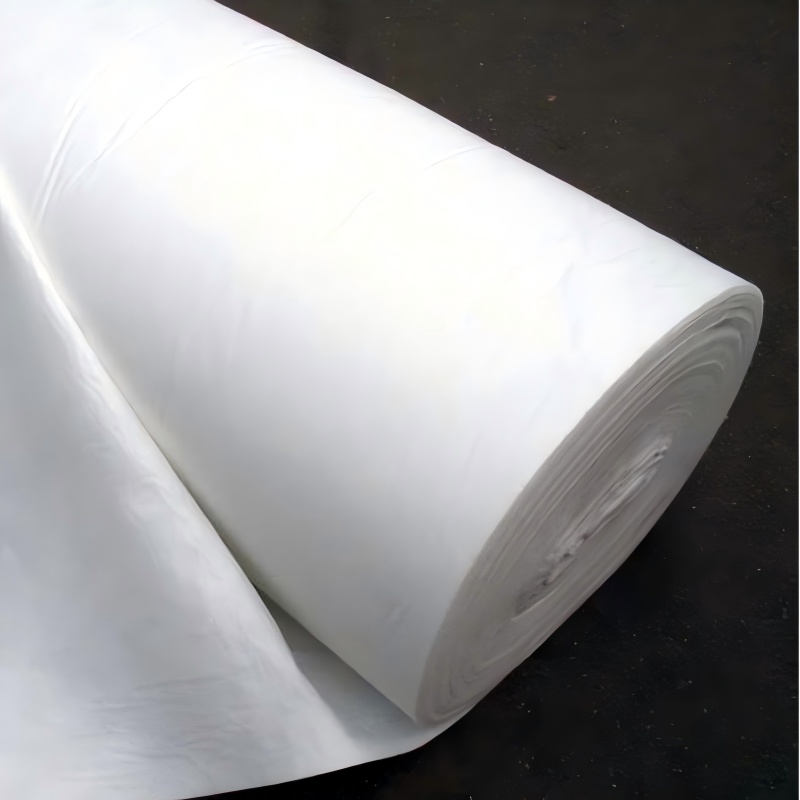
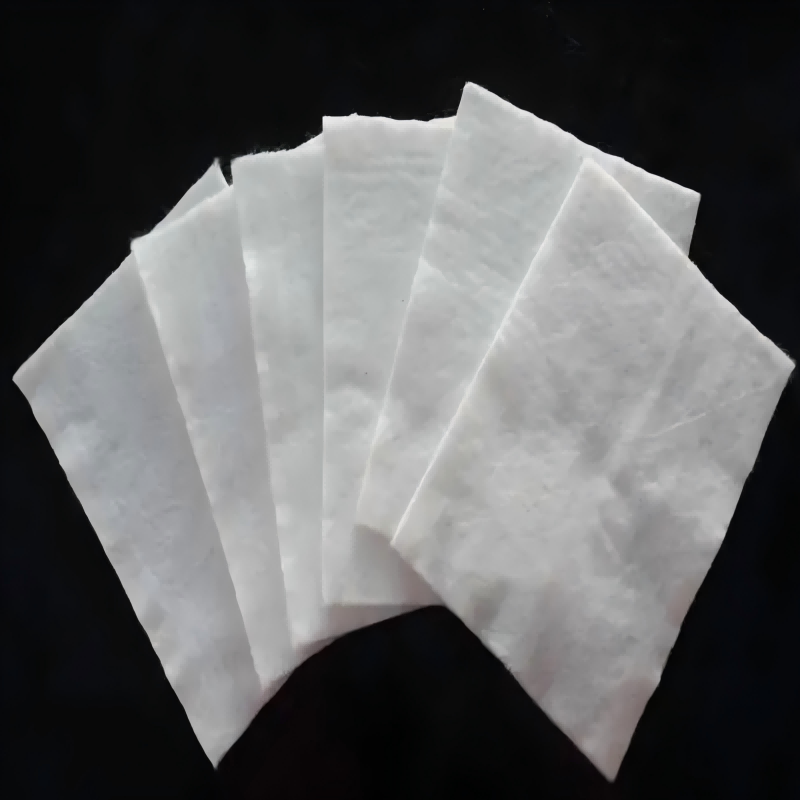
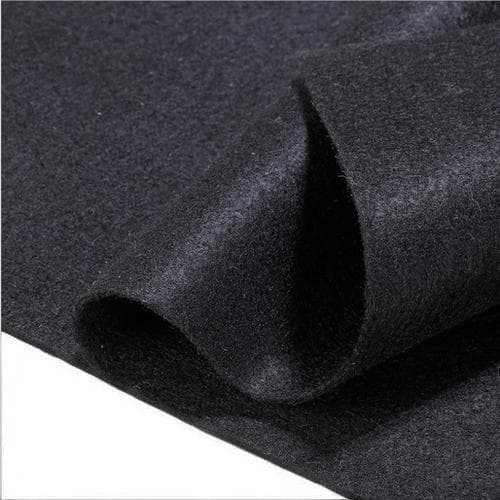
Needle Punched Geotextile
1.Excellent Permeability & Filtration:Its three-dimensional porous structure allows water to pass through freely while effectively intercepting and retaining soil particles, preventing piping and soil loss, thereby ensuring long-term, stable filtration.
2.Effective Separation:When installed between different soil layers or materials, it prevents their intermixing, maintaining the structural function and overall load-bearing capacity of each layer. It is particularly suitable for soft soil foundation treatment.
3.Reinforcement & Protection:Through fiber friction and tensile strength, it can distribute localized stresses, restrict lateral soil displacement, and enhance surface stability and resistance to shallow erosion.
4.Durability & Resistance:Synthetic fibers are chemically stable, offering resistance to acids, alkalis, microorganisms, and insect infestation. They provide a long service life when properly installed and buried.
Product Introduction:
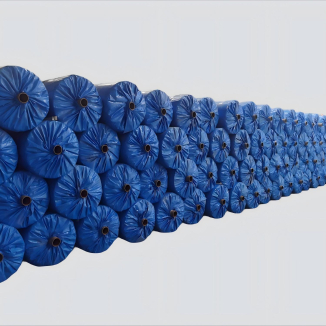
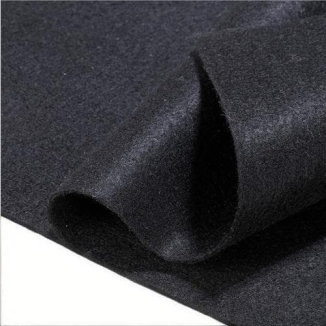
Needle Punched Geotextile is a kind of non-woven geosynthetic material made of high-quality polyester (PET) or polypropylene (PP) fibers through opening, carding and needle punching processes, forming a stable three-dimensional fiber interlocked structure. It features excellent tensile strength, good permeability, anti-aging, acid and alkali resistance, as well as outstanding functions of separation, filtration, drainage, reinforcement and protection. Widely used in highway, railway, water conservancy, landfill, slope protection and construction foundation projects, it can effectively isolate different soil layers, prevent particle loss, accelerate water drainage, strengthen soft foundation and protect waterproof and anti-seepage membranes, with stable performance, easy construction and long service life.
Product Parameters:
project | metric | ||||||||||
| Nominal strength/(kN/m) | |||||||||||
| 6 | 9 | 12 | 18 | 24 | 30 | 36 | 48 | 54 | |||
| 1 | Longitudinal and transverse tensile strength / (kN/m) ≥ | 6 | 9 | 12 | 18 | 24 | 30 | 36 | 48 | 54 | |
| 2 | Maximum elongation at maximum load in longitudinal and transverse directions/% | 30~80 | |||||||||
| 3 | CBR top penetration strength /kN ≥ | 0.9 | 1.6 | 1.9 | 2.9 | 3.9 | 5.3 | 6.4 | 7.9 | 8.5 | |
| 4 | Longitudinal and transverse tearing strength /kN | 0.15 | 0.22 | 0.29 | 0.43 | 0.57 | 0.71 | 0.83 | 1.1 | 1.25 | |
| 5 | Equivalent aperture O.90(O95)/mm | 0.05~0.30 | |||||||||
| 6 | Vertical permeability coefficient/(cm/s) | K× (10-¹~10-), where K=1.0~9.9 | |||||||||
| 7 | Width deviation rate /% ≥ | -0.5 | |||||||||
| 8 | Unit area mass deviation rate /% ≥ | -5 | |||||||||
| 9 | Thickness deviation rate /% ≥ | -10 | |||||||||
| 10 | Thickness coefficient of variation (CV)/% ≤ | 10 | |||||||||
| 11 | Dynamic perforation | Puncture hole diameter/mm ≤ | 37 | 33 | 27 | 20 | 17 | 14 | 11 | 9 | 7 |
| 12 | Longitudinal and transverse fracture strength (grab method)/kN ≥ | 0.3 | 0.5 | 0.7 | 1.1 | 1.4 | 1.9 | 2.4 | 3 | 3.5 | |
| 13 | Ultraviolet resistance (Xenon arc lamp method) | Longitudinal and transverse strength retention rate% ≥ | 70 | ||||||||
| 14 | Ultraviolet resistance (fluorescence UV lamp method) | Longitudinal and transverse strength retention rate% ≥ | 80 | ||||||||
Product Applications:
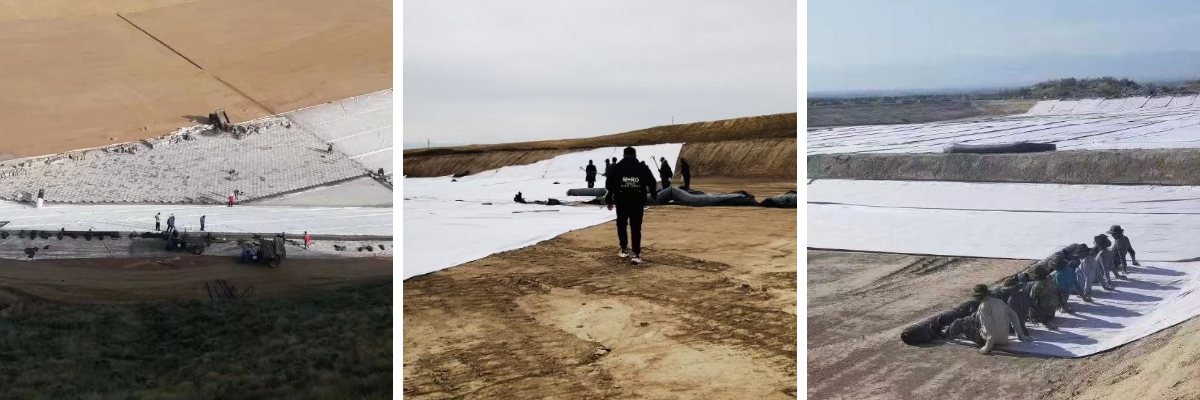
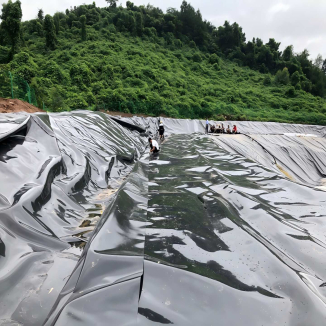
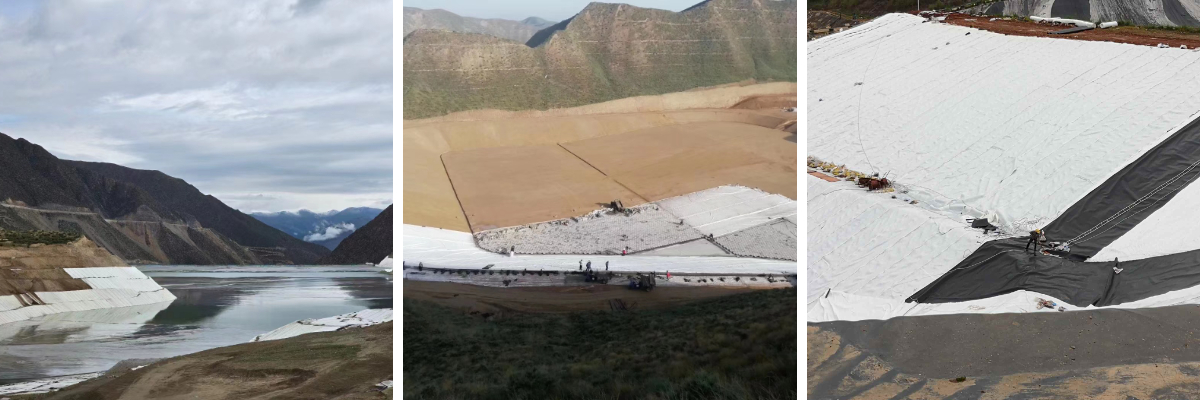
Needle-punched geotextiles are widely used in artificial irrigation channels, waterways, landscape waterways, and river dredging and improvement projects. In channel construction, they are primarily laid on the channel bottom and slopes, using a double-layer laying process as standard.
Firstly, they act as a barrier, separating the original soil foundation, gravel cushion layer, and geomembrane from each other. This prevents fine soil from mixing into the gravel layer, avoiding uneven foundation settlement, and also blocks sharp stones, protecting the geomembrane from punctures.
Secondly, they function as a reverse filtration system, achieving water permeability without soil permeability: allowing groundwater and seepage to drain smoothly, releasing soil water pressure, and preventing slope bulging and landslides; simultaneously, they trap fine soil particles, preventing soil erosion and riverbed collapse caused by water flow.
Furthermore, they provide erosion protection, buffering the direct impact of water flow and rainwater on the slope soil after laying, stabilizing the slope soil layer; when used in conjunction with ecological slope protection and vegetation planting, they can conserve soil and water, creating an ecological landscape channel.
Most importantly, the protective seepage layer is laid on top of the HDPE geomembrane. This layer acts as a buffer, isolates, and provides wear-resistant protection, preventing the geomembrane from being scratched or punctured by hard objects. This greatly improves the stability and service life of the entire channel seepage prevention system, making it very suitable for long-distance large-scale water conveyance channel projects.
Conclusion
Needle-punched geotextiles are widely used in artificial irrigation canals, landscape waterways, and river dredging and remediation projects. During construction, they are often laid in double layers on the canal bottom and slopes. They isolate the original soil, gravel cushion layer, and geomembrane, preventing soil mixing and foundation settlement, while protecting the geomembrane from punctures by sharp objects. They also have a reverse filtration and permeability function, smoothly draining seepage water, releasing water and soil pressure, and preventing slope landslides and riverbed collapses. Furthermore, they buffer water flow and rainwater erosion, stabilizing slopes, and, in conjunction with ecological slope protection, achieving both soil and water conservation and aesthetic effects. When laid on the surface of HDPE geomembrane, they provide cushioning and wear-resistant protection, significantly improving the stability and service life of the seepage prevention system, making them ideal for long-distance, large-scale water conveyance channel projects.