Vegetated Slope Protection Using Perforated HDPE Geocell
1. Introduction
Slope greening projects rarely fail because of the seed mix. They fail because the surface cannot hold soil, water, and root structure long enough for vegetation to close its canopy. Washouts, rill erosion, and shallow slumping usually appear before the plants are strong enough to protect the slope themselves. This is exactly where a perforated HDPE Geocell earns its place. The question is not whether a Geocell can be used on a green slope, but whether the perforated version is the better fit. The short answer is yes for most vegetated slopes, provided the Geocell Material, filling, and installation details are handled properly. The longer answer depends on slope angle, soil type, rainfall pattern, and what the Geocell Slope Protection is expected to achieve.
2. What a Perforated HDPE Geocell Actually Is
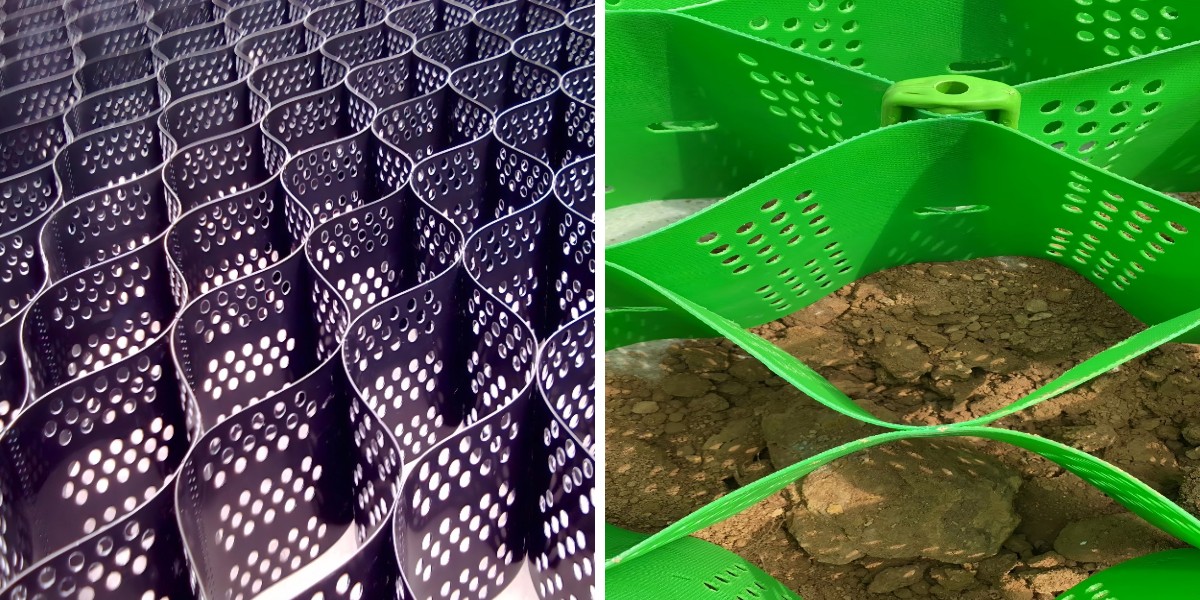
A perforated HDPE Geocell is a three-dimensional honeycomb confinement system made from high-density polyethylene strips that are ultrasonically welded into cells. The strips are expanded on site to form a flexible mattress, then filled with soil, aggregate, or a soil-amended growing medium. The defining feature is the perforation pattern in the cell walls: small openings that connect neighbouring cells. This Geocell Material is lightweight, chemically stable, resistant to rot and biological attack, and stabilised against ultraviolet degradation, which matters because the upper edges of the Geocell remain exposed to sunlight until vegetation spreads over them. The perforations are not decorative. They change how water, air, and roots move through the whole Geocell Slope Protection system.
3. Why the Geocell Material Choice Matters on Green Slopes
Not every Geocell on the market behaves the same way on a vegetated slope. The Geocell Material determines how the system responds to wetting and drying cycles, freeze-thaw action, and long-term exposure. A properly stabilised HDPE Geocell keeps its cell geometry under load and does not absorb water, so the cells do not swell, soften, or lose confinement capacity after prolonged rainfall. Material choice also affects root behaviour. Smooth, brittle, or chemically active materials can discourage root adhesion or degrade in contact with soil organisms. HDPE provides a stable, inert surface that roots can press against and weave through. When the Geocell is expected to serve as permanent Geocell Slope Protection rather than a temporary nurse structure, this durability is the deciding factor.
4. How Perforation Helps Vegetation Establish
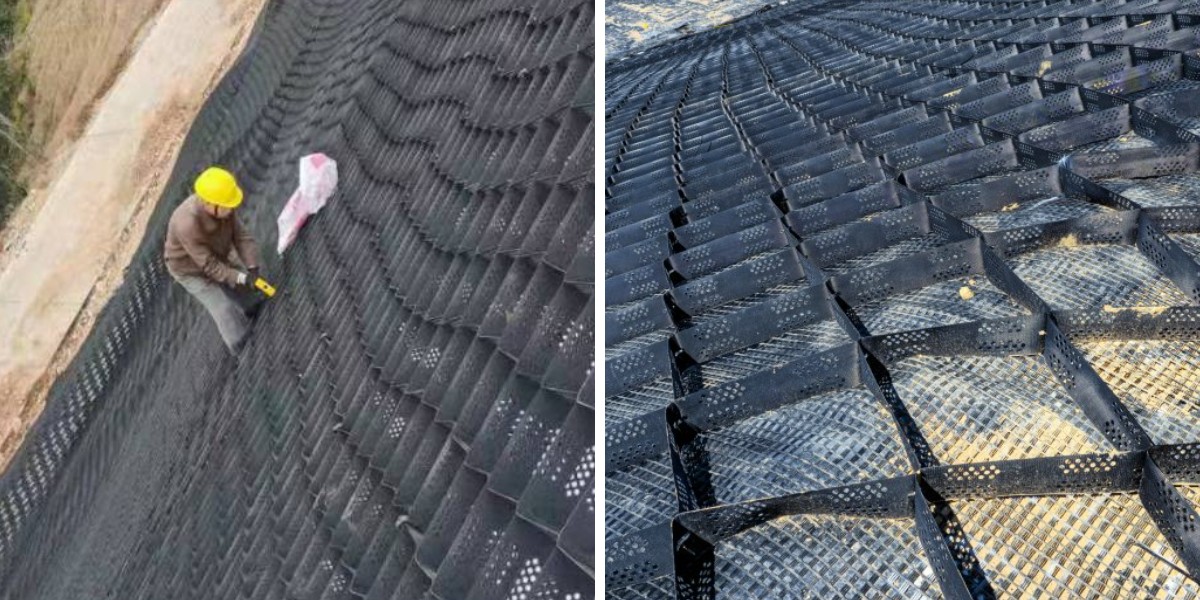
Vegetation needs three things from a slope surface: a stable seedbed, moisture that stays long enough for germination, and drainage that prevents the seedbed from drowning. Perforated walls support all three. Water moving down the slope can pass laterally between cells instead of being trapped in isolated pockets, which reduces localised saturation and the build-up of water pressure behind the filled cells. During dry spells, the openings also allow moisture and air exchange that keeps the growing medium biologically active. Roots extend through the perforations and bind adjacent cells together, so the Geocell and the plant community reinforce one another rather than behaving as two separate systems. In practice, a perforated HDPE Geocell tends to green over faster and more evenly than a closed-wall alternative, because water is distributed across the slope rather than channelled along a single path.
5. Geocell Slope Protection Performance on Vegetated Slopes
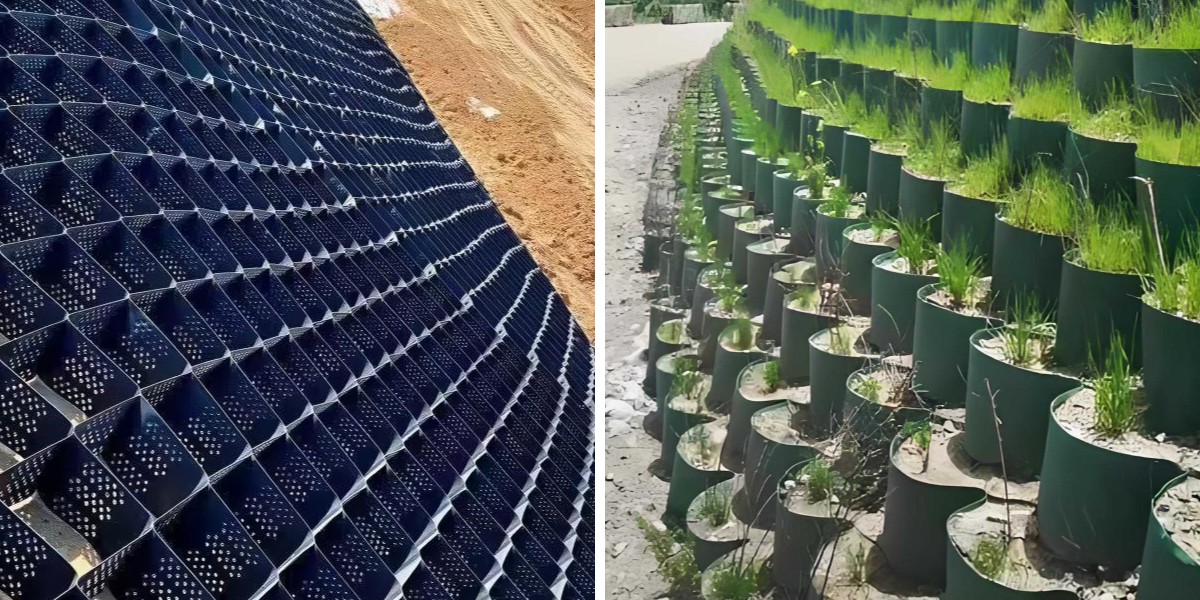
The value of Geocell Slope Protection on a green slope is that it works before the plants do. Freshly seeded slopes are at their most vulnerable, and the structure must carry that risk alone for the establishment period. The cell walls break up overland flow into small, slow-moving elements, reducing the energy available to detach and transport soil particles. Confinement keeps the growing medium in place on slopes where loose topsoil would otherwise creep or slump. Once vegetation matures, the roots and the Geocell form a composite surface layer with far greater resistance to scour than either component alone. This is the core logic of using a Geocell rather than relying on blanket erosion matting alone: the cells provide mechanical confinement, while the perforations let the biological component of the system develop without being blocked.
6. Perforated Versus Solid Geocell: Which Fits Better
A solid-wall Geocell still has legitimate uses. Where the priority is load distribution, granular infill retention, or service in a channel with sustained high flow, closed walls reduce leakage between cells and preserve structural continuity. On a slope where the goal is green cover, however, closed walls can work against the objective. They limit lateral water exchange, isolate pockets of medium that may stay either too wet or too dry, and offer roots no easy path between cells. A perforated Geocell trades a small amount of wall continuity for much better hydrological and biological behaviour. For most vegetated slopes that trade is worthwhile, but it should be a deliberate design decision, not an assumption. Where both structural duty and greening are required, the perforated HDPE Geocell is normally the more balanced option, and reinforcement detailing can compensate for the openings.
7. Design and Installation Considerations
The performance of any Geocell depends heavily on how it is installed. Prepare and shape the slope to the intended profile, remove loose material and seepage zones, and place the Geocell so that it follows the surface rather than bridging hollows. Anchor the top edge and any intermediate rows in accordance with the design, and pay attention to the toe, where runoff concentrates. Fill the cells with a growing medium that suits the local climate and the specified vegetation, avoiding heavy cohesive clay that compacts and sheds water. Seed or hydroseed promptly after filling so the surface is not left bare. Keep the fill slightly proud of the cell walls to protect the exposed Geocell Material from direct sunlight and traffic, and confirm that drainage paths at the crest and toe remain clear. Well-detailed Geocell Slope Protection fails far less often than poorly installed systems, regardless of product quality.
8. Where Perforated Geocell Is the Wrong Choice
Perforated cells are not a universal answer. On near-vertical rock faces with no soil to retain, the system has little to confine, and other measures are needed first. In channels carrying sustained high-velocity flow, lateral leakage through the openings can undermine the fill. In extremely arid or saline conditions where vegetation cannot establish at all, the biological advantage disappears and a solid-wall Geocell may serve the mechanical function better. The honest position is that a perforated HDPE Geocell is the stronger choice for vegetated green slopes under normal soil and climate conditions, and a weaker choice where vegetation is not a realistic outcome.
9. Conclusion
For vegetated green slopes, the perforated HDPE Geocell is generally the more suitable option. The perforations improve water exchange, support root interlock, and let the Geocell Slope Protection system mature into a combined soil-root-structure layer, while the HDPE Geocell Material provides the durability that long-term greening demands. The decision still belongs to the design stage: match the Geocell to the slope, the soil, and the vegetation target, install it correctly, and the structure will do its job until the plants take over. Choose the right Geocell, and the slope protects itself.