Landfill Cover Slope Stabilization: Geomat for Vegetation & Leakage Prevention
Introduction
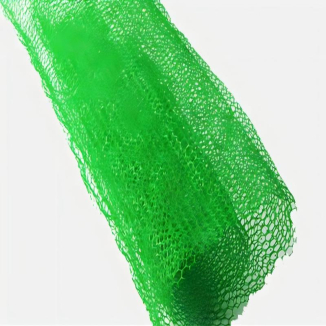
Landfill cover slope stabilization is a core part of municipal solid waste closure and ecological restoration projects. Unprotected landfill slopes face severe challenges including surface runoff scouring, soil layer slippage, sparse plant growth, and auxiliary barrier system damage, which can trigger leakage risks and damage the overall closure structure. To balance long-term slope stability, ecological greening, and anti-seepage protection, professional geosynthetic materials have become essential construction solutions. The 3D geomat serves as a multi-functional slope protection medium that integrates soil fixation and vegetation cultivation. Meanwhile, the 3d vegetation net creates a stable growth foundation for slope plants, and the erosion control geomat provides continuous anti-scouring protection for landfill cover systems. This article explores how these professional geomat materials solve common landfill slope problems and realize dual benefits of ecological restoration and leakage prevention.
1. Core Challenges of Traditional Landfill Cover Slope Protection
Traditional landfill slope protection methods rely on simple soil compaction and artificial vegetation planting, which cannot adapt to the long-term service characteristics of landfill cover projects. Landfill slopes feature gentle but long-span inclined structures, and long-term rainwater erosion, seasonal temperature changes, and slight foundation settlement will loosen surface soil layers. Bare soil slopes are prone to water and soil loss before vegetation matures, and premature plant withering often leads to secondary slope damage.
The lack of effective layered protection also threatens the integrity of the underlying anti-seepage system. Local soil loss and slope sliding may cause extrusion and friction damage to the barrier layer, inducing potential leakage hazards. In this scenario, the erosion control geomat fills the gap of traditional protection technologies. It covers the slope surface to block direct rain scouring and avoid early-stage soil loss. The flexible three-dimensional structure of 3d vegetation net locks loose slope soil steadily, creating basic growth conditions for vegetation. The systematic coverage of 3D geomat thoroughly improves the overall anti-deformation and anti-erosion capacity of landfill cover slopes.
2. How 3D Geomat Optimizes Landfill Slope Soil Stabilization
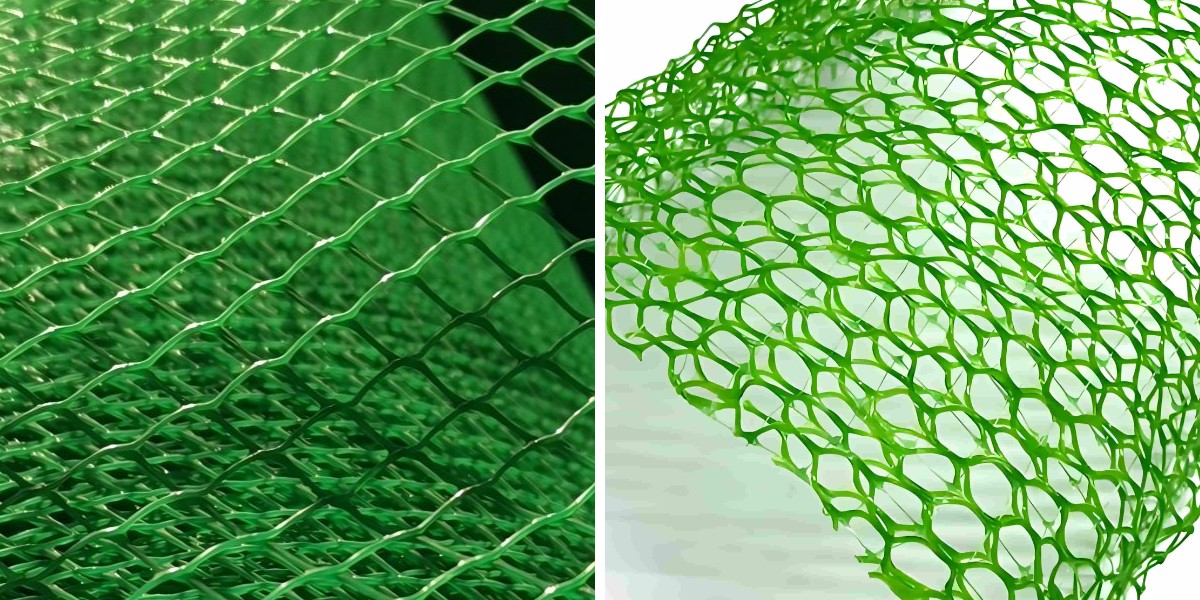
Soil fixation and layered stabilization are the core functions of 3D geomat in landfill cover projects. Different from flat geosynthetic materials, 3D geomat adopts a three-dimensional mesh structure with stereoscopic gaps, which can wrap and fix surface covering soil comprehensively. This structural feature effectively restricts lateral soil displacement and vertical settlement of slope fill, maintaining the flatness and integrity of the landfill cover surface for a long time.
In landfill slope engineering, soil layers are usually thin and loose, with poor natural cohesion. The three-dimensional space of 3D geomat can store soil and water, prevent the overall sliding of thin covering soil, and form a stable composite structure of mesh and soil. While reinforcing the slope foundation, this material reserves sufficient growth space for plant roots. Cooperating with other protection measures, 3D geomat eliminates hidden dangers of local collapse and gullies on landfill slopes, laying a solid foundation for subsequent vegetation growth and long-term slope stability.
3. 3D Vegetation Net: The Key to Sustainable Slope Greening
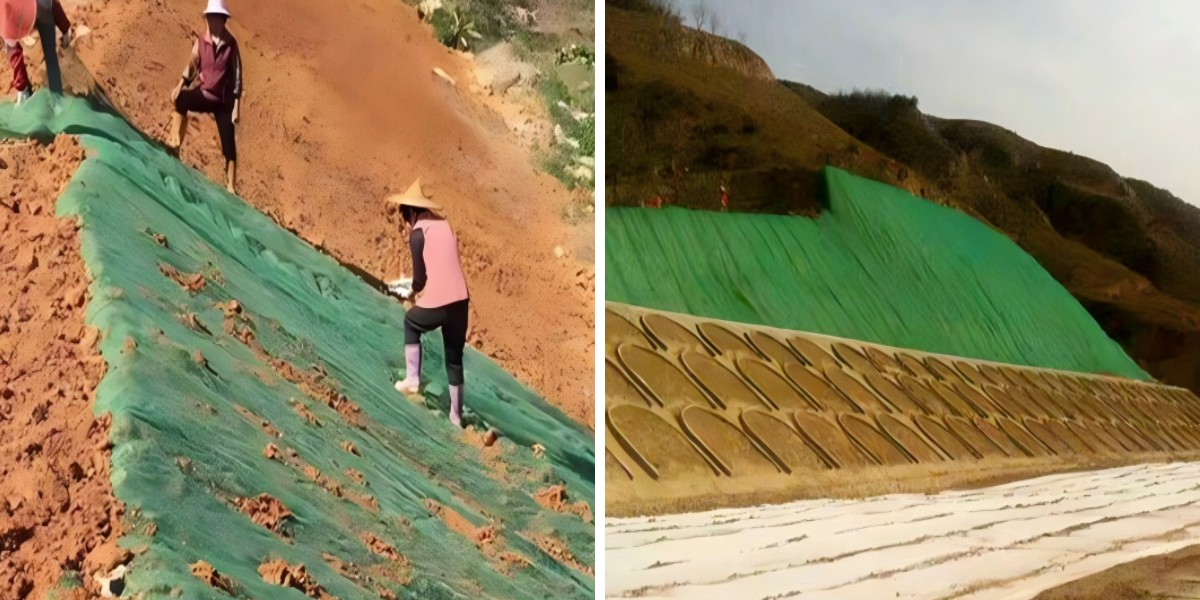
Vegetation restoration is the ultimate ecological goal of landfill cover slope treatment, and healthy and stable plant coverage is the most durable natural protection for slopes. The 3d vegetation net is specially designed for ecological slope protection scenarios, perfectly matching the vegetation growth cycle of landfill restoration projects. Its hierarchical three-dimensional mesh structure can protect newly sown grass seeds and young seedlings from being washed away by rainwater or blown away by strong wind.
In the early stage of slope construction, the 3d vegetation net acts as a protective barrier to maintain stable soil humidity and temperature, accelerating seed germination and seedling growth. In the middle and later stages, plant roots penetrate through the mesh gaps and intertwine with the net structure to form a unified root-mesh-soil composite system. This organic combination greatly enhances the overall tensile and anti-sliding performance of the slope. Compared with single artificial greening, the auxiliary protection of 3d vegetation net makes landfill slope vegetation coverage more uniform and survival rate more stable, realizing permanent ecological slope protection.
4. Erosion Control Geomat Reduces Slope Leakage Induced by Water Erosion
Most landfill cover leakage problems are indirectly caused by long-term water erosion and slope structural damage. Continuous rainwater scouring thins surface soil, destroys slope flatness, and forms water flow channels on the slope surface. Concentrated water flow will continuously infiltrate downward along damaged layers, increasing the seepage pressure of the underlying anti-seepage system and eventually triggering local leakage.
The erosion control geomat solves this problem from the source through efficient anti-scouring and drainage coordination. The compact and flexible structure of erosion control geomat disperses surface rainwater flow, avoids the formation of concentrated runoff, and reduces the downward infiltration of rainwater. By maintaining the integrity of the surface soil covering layer, it effectively protects the lower anti-seepage membrane and drainage layer from external force damage. When applied to landfill cover slopes, erosion control geomat works with vegetation systems to form a dual anti-erosion and anti-seepage protection layer, greatly reducing the risk of long-term leakage of landfill closure systems.
5. Synergistic Working Mechanism of Geomat System on Landfill Slopes
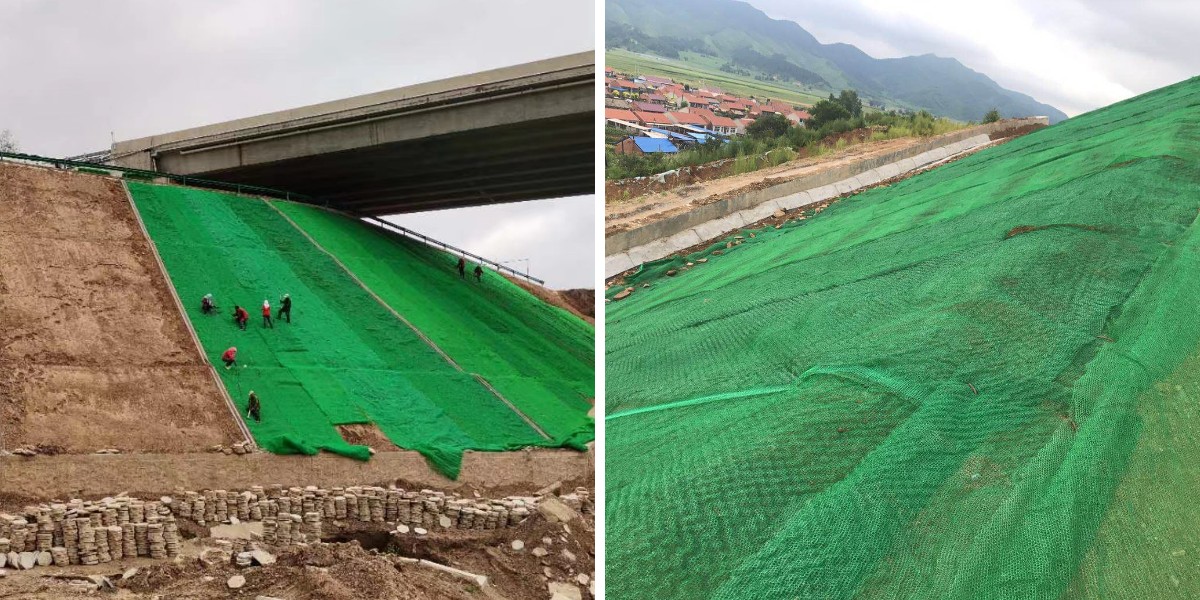
A single geosynthetic material can only realize partial protection functions, while the combined application of matched materials can form a complete closed-loop protection system for landfill cover slopes. The 3D geomat undertakes the core soil fixation and structural stabilization work, supporting the overall slope soil layer and resisting basic deformation and displacement. The three-dimensional stereoscopic structure of 3D geomat provides a stable carrier for the entire slope protection and greening system.
The supporting 3d vegetation net focuses on ecological cultivation, assisting vegetation to take root and form permanent green protection. The mature vegetation root system further strengthens the soil locking capacity of the 3D geomat structure. At the same time, the outer-layer erosion control geomat provides long-term anti-erosion protection for the entire system, resisting seasonal rainwater scouring and wind erosion. The three materials coordinate with each other to realize organic integration of structural stabilization, ecological restoration and leakage prevention, fully adapting to the complex long-term service environment of landfill cover slopes.
6. Long-Term Service Advantages of Geomat for Landfill Cover Projects
Landfill cover systems require decades of stable service, which puts forward high requirements for material durability and environmental adaptability. Professional geomat products have excellent weather resistance, aging resistance and structural stability, and can maintain intact performance in long-term outdoor exposed environments. The 3D geomat will not harden, crack or deform due to temperature changes and ultraviolet radiation, always maintaining flexible soil fixation capacity.
The 3d vegetation net has good biological compatibility, which will not hinder plant root growth or cause ecological damage, and can coexist stably with slope vegetation for a long time. The high toughness of erosion control geomat ensures that it can withstand repeated rainwater scouring and soil displacement without failure. The long-term stable working state of the three materials avoids frequent maintenance and replacement of landfill slope protection layers, reduces project operation costs, and ensures the long-term safety and ecological effect of landfill closure projects.
Conclusion
Landfill cover slope stabilization must take into account structural safety, ecological restoration and leakage prevention. As professional geosynthetic slope protection materials, 3D geomat provides core soil stabilization and structural protection, 3d vegetation net supports sustainable ecological greening, and erosion control geomat realizes long-term anti-scouring and seepage risk control. The coordinated application of the three materials effectively solves common problems such as soil loss, sparse vegetation and hidden leakage dangers in landfill slope projects. With reliable durability and excellent on-site adaptability, the geomat composite system has become the optimal solution for modern landfill cover slope stabilization and ecological restoration.