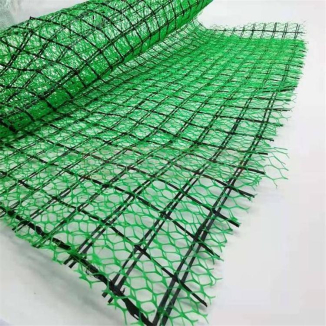
The Working Mechanism of HDPE Geocell in Soil Stabilization
Introduction
Unstable soil and slope failure are common challenges across road construction, landscaping, river regulation and land restoration projects. Traditional stabilization methods such as concrete covering and stone revetment often come with high cost, poor permeability and limited ecological compatibility. As a proven cellular confinement product, HDPE geocell has become a preferred alternative for modern ground improvement. This article explains how this geocell material locks loose soil particles and forms a stable composite layer, and explores its core value in geocell erosion control and geocell slope protection scenarios.
HDPE geocell is manufactured by welding high-density polyethylene sheets into strip units. It is folded for convenient transportation and expands into a flexible honeycomb grid on site. Once filled with soil, gravel or planting substrate, the interconnected cells turn scattered infill into an integrated structural mat. Instead of simply covering the ground surface, the geocell material changes the stress state of the soil mass itself. This fundamental difference makes geocell erosion control and geocell slope protection more adaptable to complex terrain than rigid hard protection structures.
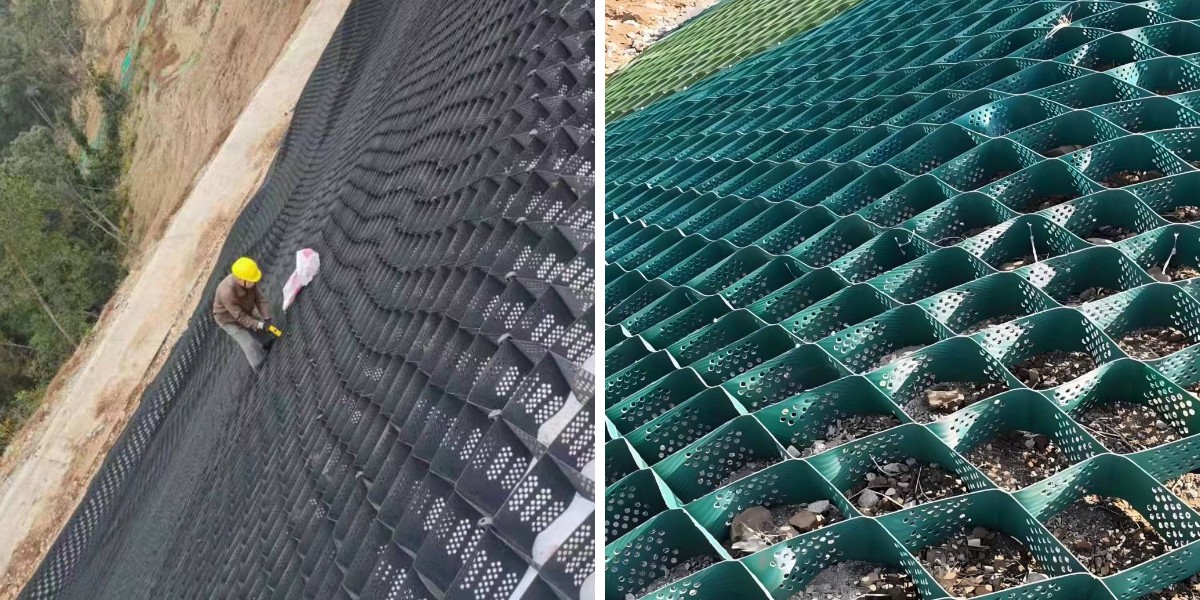
1. Lateral Confinement: The Core Mechanism of HDPE Geocell Soil Stabilization
Lateral confinement serves as the foundation of HDPE geocell stabilization performance. Loose granular soil has almost no inherent cohesion. Under external force, soil particles tend to shift outward, spread and settle, which triggers rutting, sliding and surface collapse. When infill is placed inside individual honeycomb compartments, the cell walls provide continuous passive restraint against lateral movement.
When vertical load acts on the filled layer, horizontal thrust develops inside the soil mass. The geocell material resists this outward thrust and keeps particles locked within their compartments. Particle rearrangement is restricted, and internal friction between soil grains is fully maintained. The confined soil gains apparent cohesion that pure loose soil does not have. The whole filled layer behaves like a semi-rigid slab, rather than a pile of scattered particles.
This confinement effect supports both load-bearing stabilization and surface protection. For geocell slope protection, lateral confinement stops shallow soil sliding along the slope surface. For geocell erosion control, it prevents fine soil particles from being stripped away by running water or wind shear. Even on soft subgrade, the confined composite layer distributes stress and avoids concentrated deformation.
2. Load Redistribution and Stress Transmission Inside the Cellular Structure
Beyond lateral confinement, HDPE geocell stabilizes soil through coordinated load redistribution. The interconnected honeycomb network shares stress across adjacent cells. Local pressure will not concentrate on one small area, but spreads evenly over a wider underlying soil layer.
The geocell material forms a bridging effect above weak foundation soil. Vertical loads are converted into tension force on cell walls and friction between cell walls and infill. This reduces the vertical stress transferred to the subsoil and lowers uneven settlement risk. Such working logic makes HDPE geocell suitable for temporary access roads, platform foundation reinforcement and embankment base treatment.
In geocell slope protection, this stress sharing mechanism prevents progressive failure. If local soil tends to slide, the linked cell structure pulls the unstable section back into the whole system and stops small sliding from expanding into large-scale collapse. In geocell erosion control applications, uniform stress distribution avoids localized scouring pits formed by concentrated runoff.
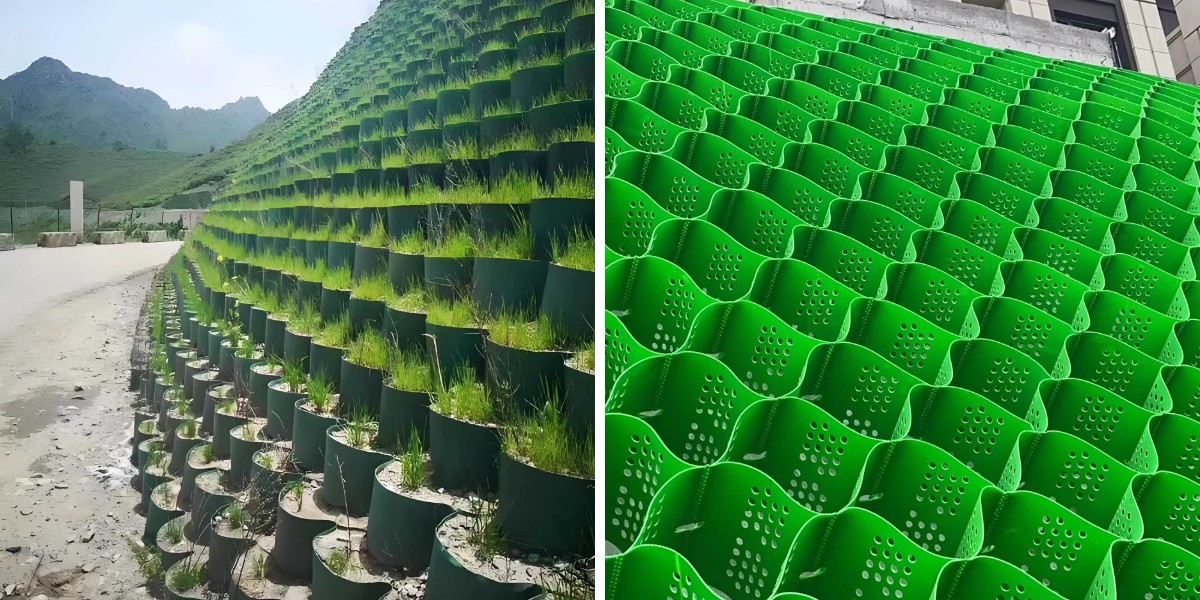
3. Hydraulic Regulation and Interface Interaction for Anti-Erosion Performance
Water is the primary trigger of soil erosion and slope instability. Rainfall impact and surface runoff carry away fine particles, soften shallow soil and weaken inter-particle friction. HDPE geocell supports geocell erosion control through unique hydraulic adjustment.
Most geocell material options are designed with perforations on cell walls. These holes allow free water exchange between adjacent cells. Pore water pressure will not accumulate inside the confined layer. Excess seepage can drain gradually instead of building up uplift pressure to lift soil blocks. Meanwhile, the honeycomb grid breaks fast-moving runoff into small streams, cutting down flow velocity and the scouring force acting on the soil surface.
The interface friction between geocell material and infill further enhances stability. Rough cell surfaces interlock with soil and aggregate grains. Relative sliding between the geocell shell and infill is restricted. For geocell slope protection, this interface bonding keeps the whole protection layer attached firmly to the slope face. Combined with vegetation planting inside cells, geocell erosion control achieves long-term ecological protection. Plant roots grow through cell openings and weave together with the geocell network, creating a composite system that gains strength over time.
4. Practical Application Boundary of HDPE Geocell in Stabilization Projects
The performance of HDPE geocell relies on correct installation matching project demands. Before deployment, engineers need to select proper cell height, welding strength and surface texture of the geocell material according to site soil type, slope gradient and water condition.
For geocell slope protection, the expanded grid must be anchored firmly onto the slope with pins or anchor ropes. Anchoring prevents the whole geocell mat from slipping along the slope before infill compaction or vegetation rooting. Infill compaction standard also matters; insufficient compaction weakens lateral confinement and reduces the effect of geocell erosion control.
HDPE geocell works well for surface stabilization, shallow sliding prevention and runoff resistance. It complements rather than replaces deep reinforcement measures for deep-seated landslide risks. Designers need to combine drainage ditches, vegetation schemes and subsoil treatment to form a complete stabilization solution.
Conclusion
HDPE geocell stabilizes soil mainly by three linked mechanisms: lateral confinement of infill particles, wide-range load redistribution and hydraulic regulation against water damage. The geocell material builds a flexible, permeable and eco-friendly stabilization system. It delivers reliable results in geocell erosion control and geocell slope protection, while cutting construction footprint compared with concrete structures.
As sustainable ground improvement solutions keep growing popular, HDPE geocell will remain a practical choice for balancing engineering stability and ecological restoration. Understanding its working mechanism helps engineers and buyers select suitable specifications and arrange proper construction steps to maximize long-term performance on site.