Success Story: Landfill Slope Restoration Using Reinforced 3D Geomat
Introduction
Closed landfill sites bring unique ecological challenges. Exposed cover slopes face persistent surface runoff, soil loss, and difficulty establishing stable vegetation. Without proper protection, rainfall scours topsoil away, triggers slope surface failure, and disturbs landfill closure systems. Many traditional restoration approaches struggle to balance erosion resistance and ecological recovery. This real‑world success story showcases how reinforced 3d geomat solved complex landfill‑closure challenges. Geomat for Slope Protection acted as the core stabilization component, while the 3d vegetation net trapped growing medium and supported plant colonization. The erosion control geomat delivered durable mechanical protection throughout the whole restoration cycle. This article walks through project background, key challenges, solution implementation, and final project outcomes.
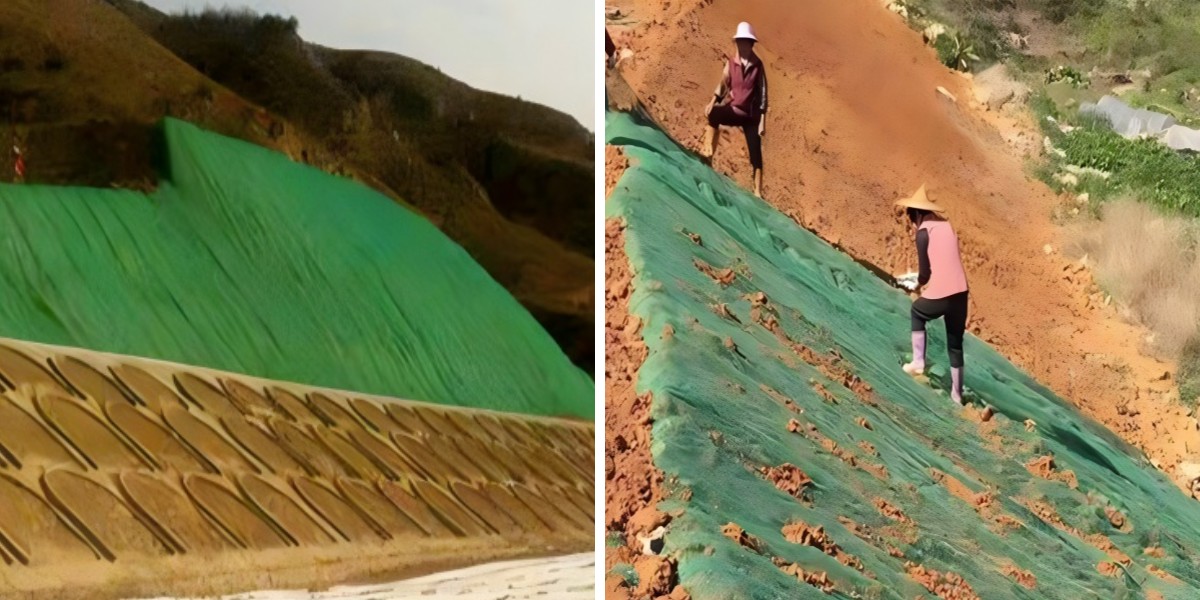
1. Project Background & Core Landfill Slope Challenges
This landfill‑closure project targeted aged waste‑site cover slopes that required full ecological restoration. After landfill operation ceased, man‑made cover slopes were formed over waste layers. Site crews encountered multiple tricky obstacles before restoration. Loose cover soil was extremely vulnerable to rain‑wash, and newly spread topsoil tended to slide down gradient during heavy storm events.
Geomat for Slope Protection was shortlisted after evaluating multiple slope‑treatment options. Conventional spray‑seeding alone could not hold soil and seeds in place on long‑term exposed slopes. A reinforced 3d geomat was selected to deliver both mechanical restraint and vegetation‑growing conditions. The 3d vegetation net structure was expected to lock surface substrates, while erosion control geomat would resist repeated rainfall impact before plants formed full surface cover.
Additional site constraints included strict environmental compliance requirements for closed landfills. Any applied material could not damage underlying anti‑seepage structures. The whole restoration system had to tolerate long‑term outdoor exposure and adapt to local seasonal weather shifts. These practical demands made geosynthetic‑based restoration a highly suitable technical path.
2. Project Solution: Reinforced Geosynthetic System Design
Engineers built the restoration scheme centered on Geomat for Slope Protection. Reinforced 3d geomat served as the primary surface protective layer across the entire landfill slope. The three‑dimensional structure of the 3d vegetation net created stable cavities to hold planting soil and seed mixtures, preventing substrate slipping under gravity and surface water flow.
Every panel of erosion control geomat was carefully matched to site slope features. Design teams focused on reliable anchoring and panel overlap to keep the whole system fixed on slope surfaces. Proper fastening prevented shifting before vegetation took root, a critical detail for landfill‑cover safety.
Geomat for Slope Protection worked together with native‑species seed blends selected for local climate. The reinforced 3d geomat did not block underground water vapor exchange. The open structure of the 3d vegetation net allowed plant roots to penetrate freely. Erosion control geomat offered physical shielding against raindrop splashing, greatly lowering the risk of rill and gully erosion during the vulnerable early‑growth phase. This integrated design combined geosynthetic mechanical strength with natural vegetation restoration.
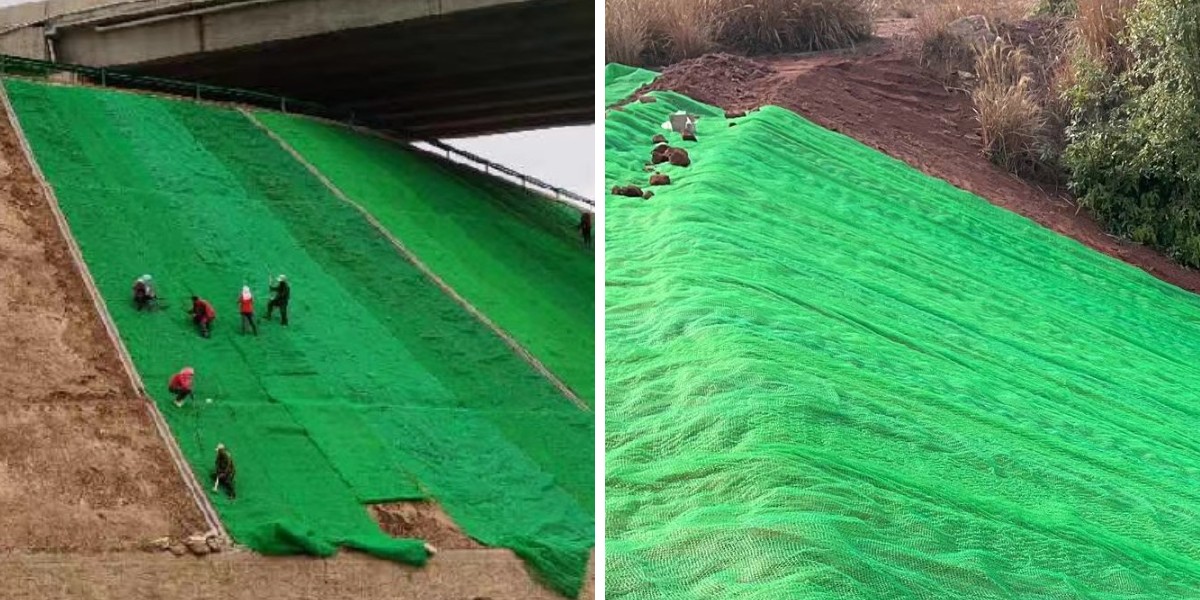
3. On‑Site Implementation of the 3D Geomat Restoration System
Site preparation formed the first important step before deploying any material. Operators smoothed slope surfaces and cleared sharp debris that might harm Geomat for Slope Protection. After surface finishing, reinforced 3d geomat was unfolded following slope contours. The 3d vegetation net faced outward to receive growing medium and seeds.
Firm anchoring and panel overlapping guaranteed erosion control geomat stayed closely attached to slope surfaces. Gaps and wrinkles were eliminated to avoid hidden water‑flow channels underneath the material. Once Geomat for Slope Protection was secured, seed‑carrying growing medium was applied onto the surface of reinforced 3d geomat. The mesh cavities of the 3d vegetation net captured and stored this medium firmly.
During construction, crews paid close attention to slope crest and slope toe zones, two high‑risk erosion areas. Erosion control geomat was strengthened in these transition zones. All construction steps followed landfill‑closure specifications, making sure installation activities would not compromise the underlying anti‑seepage liner system. No heavy mechanical equipment ran directly on finished geomat sections to prevent hidden material damage.
4. Observed Project Outcomes & Long‑Term Performance
After construction completion, the project entered a vegetation‑cultivation period. The Geomat for Slope Protection resisted short‑term storm impacts before seeds germinated. Reinforced 3d geomat held substrates securely, and the 3d vegetation net offered favorable micro‑environment for seed sprouting. Gradually, native plants spread across the slope surface.
Once plant root systems intertwined with erosion control geomat, a composite soil‑plant‑geosynthetic protective layer came into being. Surface soil loss was effectively eliminated. No obvious sliding or scouring traces appeared on restored landfill slopes even under seasonal heavy rainfall.
Beyond anti‑erosion performance, the Geomat for Slope Protection helped the landfill site meet ecological‑restoration acceptance standards. Reinforced 3d geomat maintained its structural integrity under long‑term outdoor exposure. The 3d vegetation net stayed embedded within root networks, rather than degrading or detaching from the slope. Erosion control geomat fulfilled its intended function without bringing secondary pollution risks for the closed landfill. The project proved that geosynthetic‑centered restoration can deliver stable, compliant landfill‑closure results.
5. Key Takeaways for Landfill‑Slope Restoration Projects
This landfill‑restoration success story delivers practical lessons for similar closure works. Selecting proper Geomat for Slope Protection is only the starting point. Reinforced 3d geomat must match site‑specific slope conditions and local climate. The 3d vegetation net cannot work well without correct substrate preparation and native‑plant seed selection. Even high‑quality erosion control geomat will underperform if anchoring or overlap details are ignored.
Landfill‑cover slopes carry special risks; any protective system must avoid damaging underlying anti‑seepage facilities. Early‑stage protection from geosynthetics is vital, as vegetation requires time to develop full protective capacity. Relying purely on plant growth without Geomat for Slope Protection often leads to restoration failure. Reinforced 3d geomat bridges the gap between construction completion and mature vegetation coverage. The 3d vegetation net captures soil and seeds, and erosion control geomat bears erosion pressure in this critical transition window.
Conclusion
This landfill‑slope restoration case demonstrates the real‑world value of geosynthetic ecological solutions. Geomat for Slope Protection formed the core of this successful closure project. Reinforced 3d geomat locked surface substrates, the 3d vegetation net supported plant establishment, and erosion control geomat provided reliable anti‑scour protection in early service stages. By combining geosynthetic mechanical performance with native‑vegetation recovery, the project achieved stable slope safety and ecological restoration for a closed landfill. For similar waste‑site closure assignments, this solution offers a replicable, practical reference for global engineering practitioners.