The Practical Application of HDPE Geocell in Slope Protection Projects
Introduction
Slope instability and surface erosion bring long-standing troubles to infrastructure construction, highway cutting, riverbank renovation and ecological restoration works. Traditional slope treatment methods often face high construction cost, complicated operation and poor ecological compatibility. HDPE geocell, as a three dimensional honeycomb geosynthetic product, offers an efficient solution for slope treatment. Geoweb Slope Protection makes full use of the cell-constraint effect to fix infill materials and resist slope surface displacement. Geocell Material creates stable structural support for inclined surfaces when filled with soil, gravel or planting medium. Mastering the practical application features of HDPE geocell helps designers and contractors formulate reasonable schemes for diverse slope protection projects.
Basic Understanding of HDPE Geocell for Slope Works
HDPE geocell is a three-dimensional honeycomb-shaped geosynthetic structure manufactured from high-density polyethylene strips welded together. It can be folded flat for convenient transportation and expands into interconnected honeycomb units on site. After unfolding, each cavity is filled with soil, aggregate or planting substrate to form a rigid reinforced layer.
Geoweb Slope Protection is a typical engineering solution built upon HDPE geocell. The expanded cell structure restrains infill materials from sliding down along the slope face. Geocell Material obtains excellent antiaging and anti-tear features from high-density polyethylene raw material, adapting well to outdoor open-air slope environments.
Different types of HDPE geocell are available for varied project scenarios. Some HDPE geocell focuses on hard anti-sliding reinforcement, while others are optimized for vegetation restoration. Geoweb Slope Protection can adjust infill options according to project goals. Geocell Material performance directly determines the long-term service effect of the whole slope system, so material quality assessment should never be ignored in early-stage project planning.
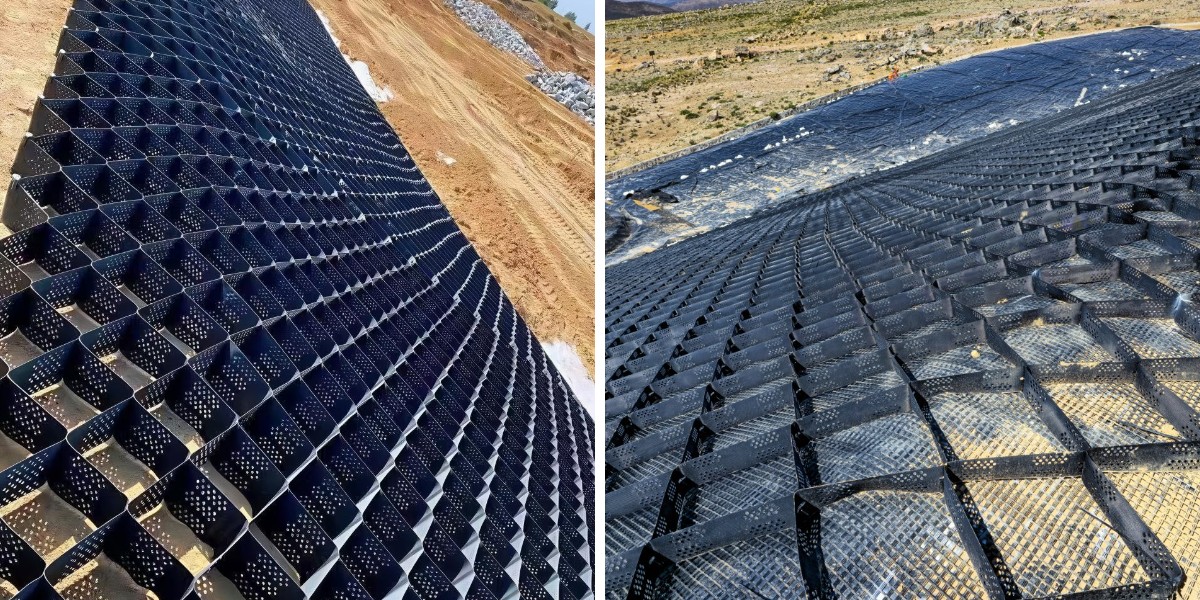
How HDPE Geocell Realizes Geoweb Slope Protection Mechanism
The core working principle of Geoweb Slope Protection lies in the three-dimensional confinement effect generated by HDPE geocell. When HDPE geocell is unfolded and fixed on slope surfaces, each honeycomb compartment holds infill materials tightly. The lateral restriction from cell walls limits particle movement and stops infill from slipping under rainwater washing and gravity influence.
Without proper restraint, loose soil or gravel on inclined surfaces tends to migrate downward. HDPE geocell divides the slope surface into multiple independent small units. This confinement disperses slope stress and reduces the risk of shallow-layer sliding. Geoweb Slope Protection combines physical anti-sliding performance with flexible construction characteristics. Geocell Material maintains cell shape under continuous tensile stress, ensuring the confinement structure will not collapse under long-term environmental exposure.
Anchor fixtures play a vital role during field deployment. Anchors fix HDPE geocell firmly to slope substrate and prevent the whole geosynthetic layer from creeping downwards. Only when HDPE geocell stays fully expanded and tightly attached to base surface can Geoweb Slope Protection work as expected. Even highgrade Geocell Material cannot achieve ideal protection results if anchoring layout is improper.
Ecological and Engineering Values of Geocell Material in Slope Projects
Geocell Material balances mechanical performance and ecological adaptability, which makes HDPE geocell widely accepted in modern slope protection projects. Compared with hard concrete covering, HDPE geocell supports ecological restoration while retaining structural stability.
When HDPE geocell cavities are filled with planting soil, vegetation can take root inside each cell unit. Plant roots further interlock with Geocell Material and infill medium, forming a combined protection system of plant and geosynthetics. Geoweb Slope Protection in this mode realizes both slope stabilization and landscape greening, which fits environmental friendly construction requirements.
For rocky slopes and severely weathered slope sections, HDPE geocell can be filled with gravel to form hard protective layers. Geoweb Slope Protection in such conditions resists rain-splashing erosion and surface collapse. Geocell Material tolerates temperature changes and ultraviolet exposure in open-air sites, avoiding premature aging and failure. Project teams can adjust infill types according to slope gradient, surrounding environment and design objectives to maximize the value of HDPE geocell.
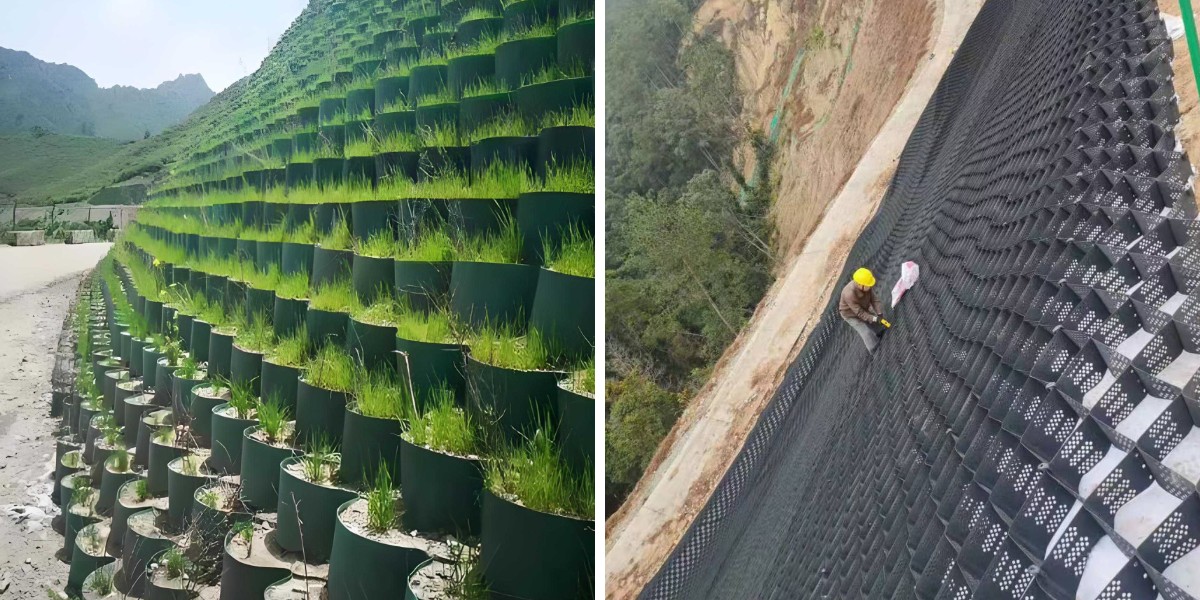
Key Application Scenarios for HDPE Geocell in Geoweb Slope Protection
HDPE geocell covers multiple typical slope related engineering scenarios. Highway and railway cut-slopes are major application fields. HDPE geocell is laid on exposed cutting slopes to control shallow sliding risks. Geoweb Slope Protection here prevents roadbed damage caused by slope failure. Geocell Material accommodates repeated climate changes alongside traffic infrastructure.
River and reservoir bank slopes also benefit greatly from HDPE geocell. Under wave impact and water level fluctuation, bare riverbanks suffer continuous erosion. HDPE geocell fixes bank side infill materials. Geoweb Slope Protection mitigates scouring damage from running water. Geocell Material remains stable under periodic wet-dry cycles, which is critical for hydraulic related slope sites.
Land restoration and mining reclamation slopes represent another important scenario. HDPE geocell provides stable growing matrix carrier for degraded land. Geoweb Slope Protection stops soil loss on reconstructed terrain. Geocell Material supports vegetation establishment and helps restore local ecological landscape. Each scenario demands customized infill selection and anchoring arrangement for HDPE geocell.
Practical Installation Guidance for HDPE Geocell Projects
Perfect performance of HDPE geocell cannot be separated from standardized construction operations. Before laying HDPE geocell, slope surface shall be cleaned to remove sharp rock protrusions and loose floating soil, creating smooth substrate conditions.
Unfold HDPE geocell along the slope contour and keep honeycomb cells fully stretched. Apply anchor spikes at top edge, bottom edge and cell seams to lock the whole structure. Geoweb Slope Protection will be weakened if HDPE geocell stays partially folded. Geocell Material should avoid being scratched or punctured during handling and laying.
Carry out infill work after anchoring completes. Fill each compartment evenly and avoid local overloading. For ecological schemes, select suitable planting medium for HDPE geocell cavities. For anti-scour schemes, gravel infill is preferred. After infill finishes, conduct necessary inspection. Check whether HDPE geocell keeps expanded state and whether anchors stay in place. Geoweb Slope Protection relies on complete structure. Damaged Geocell Material sections need timely repair before finishing subsequent working procedures.
Conclusion
HDPE geocell serves as a versatile three-dimensional geosynthetic solution for slope protection projects. Relying on three-dimensional confinement effect, HDPE geocell delivers reliable anti-sliding and anti-erosion capacity. Geoweb Slope Protection realizes both hard-type reinforcement and ecological greening by adjusting infill materials. Geocell Material offers solid physical properties to adapt to highway slopes, river banks and land reclamation sites.
Reasonable site preparation, standardized unfolding, anchoring and infill operations enable HDPE geocell to exert full performance. For contractors and designers, full consideration of site features helps make good use of Geoweb Slope Protection and qualified Geocell Material to achieve long-term stable slope protection outcomes.