Settlement Reduction Effect of HDPE Geocell on Soft Clay Foundation
1. Introduction to Soft Clay Foundation Behaviour
Soft clay foundations present one of the most persistent challenges in civil engineering, because their low shear strength and high compressibility allow structures and pavements to sink gradually under repeated loading. When a road, storage yard or embankment is built directly on such ground, the soil cannot mobilise enough resistance to carry the imposed load, and the result is differential settlement that damages the surface layer, disrupts drainage and shortens service life. Engineers have therefore searched for a reinforcement system that improves load distribution without requiring excavation and replacement of the entire weak stratum. The HDPE Geocell has become a widely adopted answer to this problem, because it converts a weak, deformable subgrade into a confined, stiffer composite mass. Understanding how this Geocell Material interacts with soft clay is essential before designing any Geocell Road Base Reinforcement layer, and the same physical behaviour that limits settlement also explains why Geocell for Erosion Control performs so well on vulnerable slopes.
2. The Fundamental Problem of Weak Subgrade Deformation
A soft clay foundation fails through two connected mechanisms. First, the soil lacks frictional interlock, so particles slide past one another when loaded. Second, the clay contains water that cannot drain quickly, which generates excess pore pressure and allows the mass to deform sideways. This lateral spreading is the real cause of vertical settlement, because material displaced from beneath the load has to move outward before the surface can drop. Any effective solution therefore has to restrict lateral movement rather than simply resist downward force. The HDPE Geocell addresses precisely this behaviour: its three-dimensional cellular structure traps soil inside individual pockets and prevents the outward migration that would otherwise occur. When the same principle is applied to a granular base layer, Geocell Road Base Reinforcement transforms a loose aggregate blanket into a stiff raft that spreads load across a wider area of the soft clay beneath.
3. Working Principle of the HDPE Geocell System
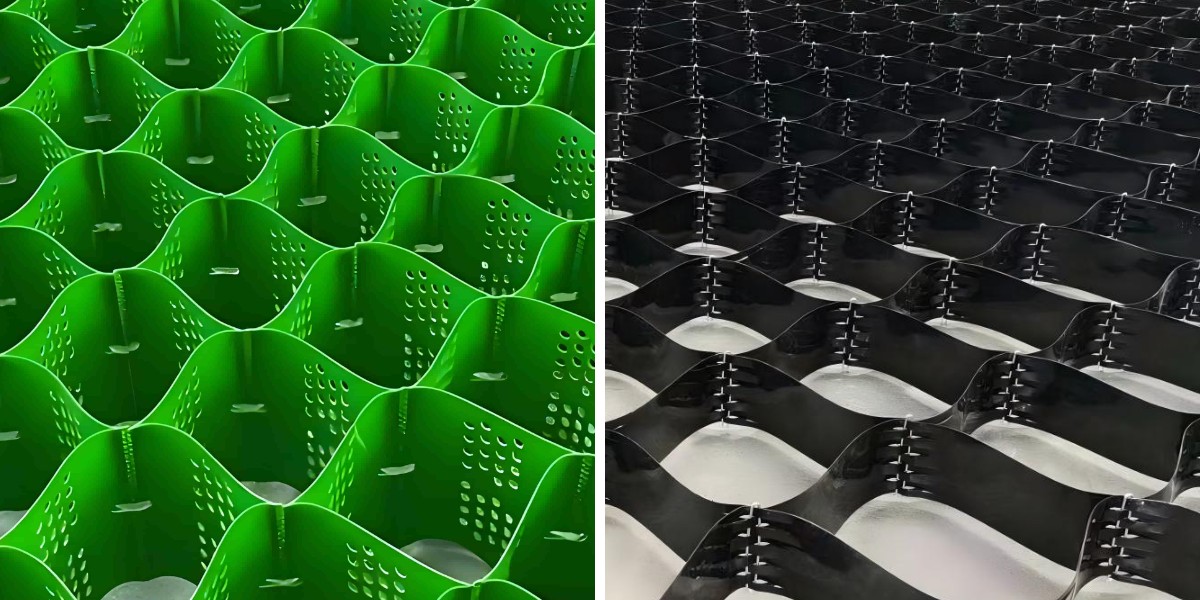
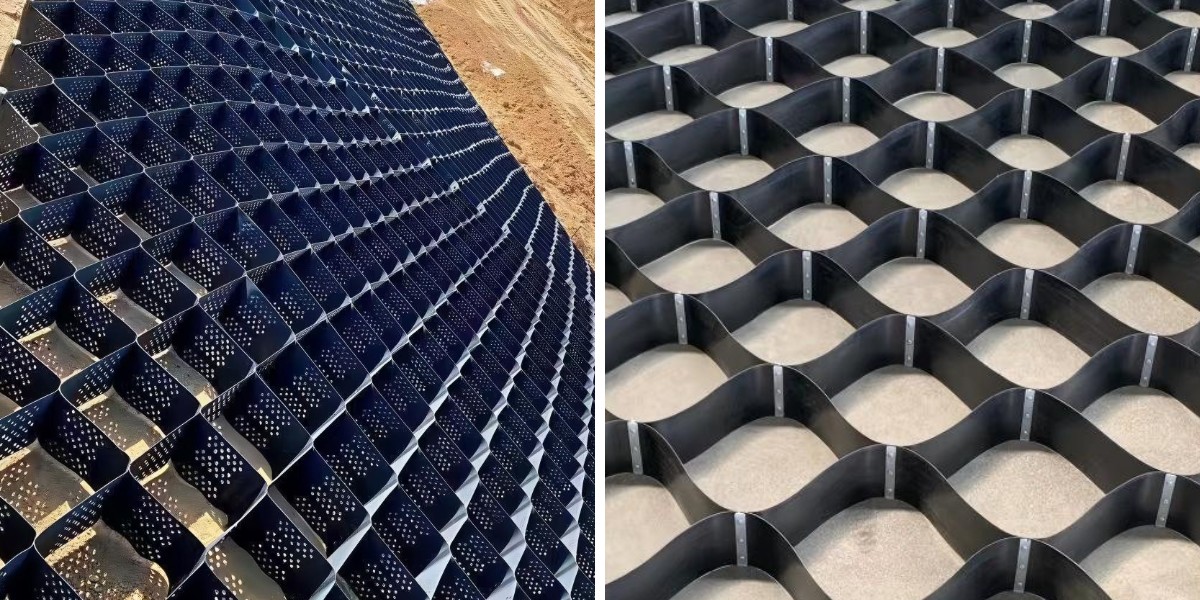
The HDPE Geocell is manufactured from high-density polyethylene strips that are ultrasonically welded into a honeycomb pattern, then delivered collapsed and expanded on site. Once expanded and filled with granular material, the cell walls act as vertical confining membranes. Load applied at the surface is resisted by the friction between the infill and the cell walls, while the walls themselves carry tensile hoop stress and prevent the infill from bulging outward. This confinement raises the apparent cohesion and angle of internal friction of the infill material, which means the composite layer behaves far more stiffly than the same aggregate placed without cells. Because the Geocell Material is flexible rather than rigid, it follows local yielding of the soft clay without cracking, maintaining contact with the subgrade and continuing to distribute load. This combination of confinement and flexibility is what allows the HDPE Geocell to reduce settlement rather than merely postpone it.
4. Mechanism of Settlement Reduction Under Static Loading
When a load is applied to an unreinforced granular layer over soft clay, the aggregate punches down and the clay displaces laterally, producing a deep depression directly under the wheel path or footing. Introducing an HDPE Geocell at the base of the granular layer changes the load path. The cell walls mobilise a membrane effect, transferring part of the vertical stress outward into adjacent cells, so the pressure bulb beneath the load becomes wider and shallower. Because the pressure is spread over a larger area, the stress reaching the soft clay drops, and the corresponding consolidation settlement falls with it. Additional resistance comes from the rough interface between the reinforced layer and the subgrade, which acts as a slip-resistant base and prevents the granular mass from sliding sideways. In practice this means a properly designed Geocell Road Base Reinforcement layer can support traffic on ground that would otherwise require deep replacement, and the same confinement logic explains the mechanical stability that makes Geocell for Erosion Control effective on shallow slopes.
5. Applications in Geocell Road Base Reinforcement
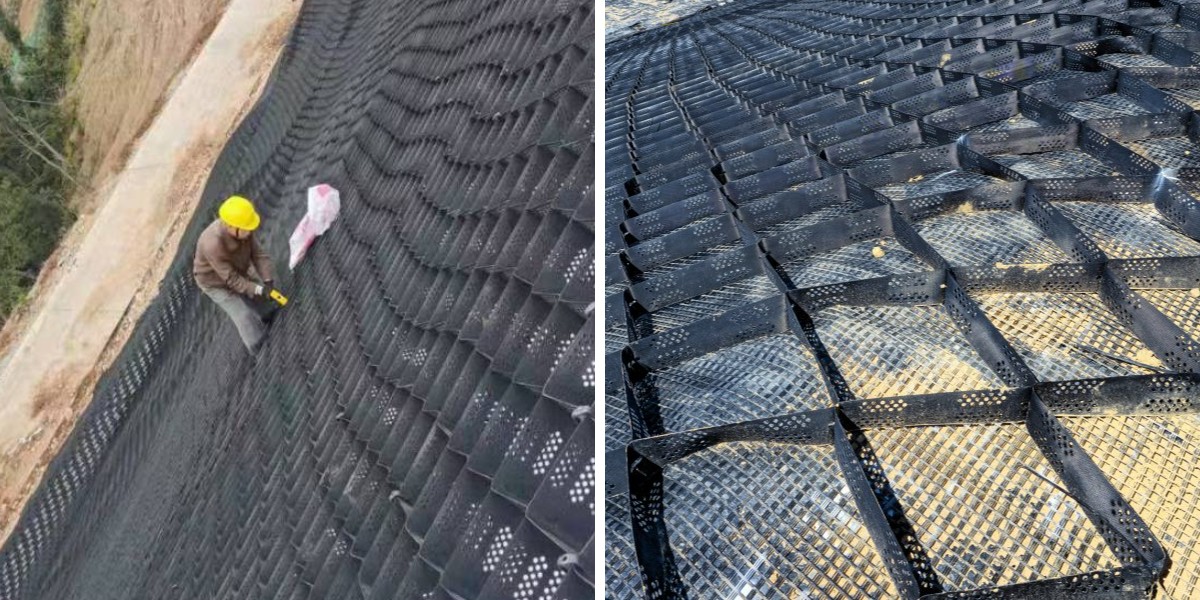
Road construction over soft clay is the most common field of use for this technology. The HDPE Geocell is placed directly on the prepared subgrade, filled with crushed stone or local granular material, and compacted in lifts. The resulting layer performs several functions at once: it acts as a separator that prevents aggregate from penetrating into the soft clay, as a reinforcement that limits lateral spreading, and as a drainage path that allows water to escape rather than accumulate under the pavement. Because the Geocell Material is chemically inert and resistant to biological attack, it retains its confinement ability over long service periods, which matters greatly where maintenance access is difficult. Designers who specify Geocell Road Base Reinforcement on soft clay typically reduce the required granular thickness, because the confined layer achieves the necessary stiffness with less material. The same product family also serves haul roads, container yards and embankment working platforms, where the HDPE Geocell prevents rutting and keeps the surface serviceable under repeated wheel loads.
6. Role of Geocell for Erosion Control on Disturbed Ground
Settlement reduction and erosion control are not separate subjects; they share the same underlying mechanism of confinement. On cut slopes, embankment faces and drainage channels, the HDPE Geocell is laid on the prepared surface and filled with soil or gravel, forming a cellular mattress that holds the surface material in place. Because each pocket restrains its infill, runoff cannot easily dislodge particles, and the Geocell Material protects the slope face from rill and gully development. Where vegetation is established within the cells, root systems combine with the Geocell for Erosion Control function to create a reinforced vegetated surface that resists both surface wash and shallow sliding. On projects where soft clay foundations border watercourses or lagoons, this dual capability is especially valuable, because the same HDPE Geocell specification can stabilise the subgrade beneath a road and protect the adjacent slope from scour, reducing the number of different materials the contractor must stock.
7. Influence of Geocell Material Properties on Performance
Performance depends heavily on the quality of the Geocell Material itself. High-density polyethylene is chosen for its tensile strength, resistance to ultraviolet degradation and stability in contact with aggressive soils. The strips must maintain adequate wall stiffness so that cells do not collapse during filling, and the weld seams must retain integrity under sustained load. A HDPE Geocell with consistent geometry and reliable joints confines infill predictably, whereas a product with variable cell dimensions or weak seams allows the granular layer to deform locally and settlement returns. Engineers should also consider the interface friction between the Geocell Material and the subgrade, because a smooth, low-friction base permits sliding even when the cells themselves are strong. When specifying Geocell Road Base Reinforcement, matching the cell height and pocket size to the grading of the available infill improves interlock, and the same attention to material specification determines whether Geocell for Erosion Control will hold surface material on a steep face or fail during the first heavy rainfall.
8. Installation Practice That Preserves the Design Intent
Correct installation is as important as correct specification. The soft clay subgrade must first be trimmed, cleared of standing water and protected from trafficking, because disturbance before placement destroys the surface integrity the HDPE Geocell relies on. The collapsed cells are expanded across the prepared area, anchored at the extremities and joints, then filled from the leading edge so that expansion is maintained. Compaction must be carried out in controlled lifts, with care taken not to displace the cell walls or overstress the soft clay beneath. Where the same Geocell Material is used for slope protection, cells are anchored into a stable bench at the crest and the toe is keyed into firm ground, which is standard practice for Geocell for Erosion Control. Proper sequencing ensures the Geocell Road Base Reinforcement layer behaves as a single composite raft rather than a collection of disconnected pockets.
9. Design Considerations and Long-Term Performance
Designers working with soft clay should treat the reinforced layer as part of a system that includes the subgrade, the infill and the drainage regime. The HDPE Geocell improves load spreading, but it cannot compensate for a subgrade so weak that it fails in bearing, so site investigation remains essential. Drainage is equally important: if water accumulates within the confined layer, pore pressures rise and the benefit of the Geocell Material is reduced. Long-term performance also depends on protecting the cells from construction damage and from exposure to sustained ultraviolet radiation before fill placement. When these conditions are respected, Geocell Road Base Reinforcement continues to limit differential movement throughout the design life, and the associated Geocell for Erosion Control measures on adjacent slopes remain stable, forming a coherent approach to ground improvement rather than a series of isolated interventions.
10. Conclusion
The settlement reduction effect of the HDPE Geocell on soft clay foundation is a direct consequence of lateral confinement. By preventing the outward displacement that would otherwise accompany vertical loading, the cellular structure converts a weak, compressible stratum into a stiff composite base that spreads load efficiently and keeps surface deformation within acceptable limits. This principle supports its use in Geocell Road Base Reinforcement, where confined granular layers replace thick imported fill, and it also underpins Geocell for Erosion Control, where the same cellular restraint protects slopes and channels from surface loss. Selecting a durable Geocell Material and installing it correctly ensures that the confinement mechanism works as intended for the full service life of the asset, making high-density polyethylene geocells a dependable solution wherever soft ground must carry load.